What is a harem visual novel? Routes, endings and tropes explained
21 November 2026. Written by the Pomomi team. We make the Pomomi series in this guide, and say so wherever one appears.
Harem is one of the most used words in anime and visual novels, and one of the most misread. It sounds like it should mean something explicit. In practice it describes the shape of the cast: one lead, several people who are interested in them, and a story about who ends up with whom. This guide explains the word, how it works in a visual novel with routes and endings, the tropes you will meet, and how harem differs from reverse harem. We use our own series, Reincarnated Into Harem Game, as the worked example, because we know exactly how it is built.
What harem means
In anime, manga, light novels and games, a harem story has a main character surrounded by several possible romantic partners, usually three or more. The word borrows from the historical part of a household set aside for women. The genre grew up in Japan from the 1970s, became much more popular with dating sims in the late 1980s and 1990s, and had another boom in the 2010s with web novels about overpowered heroes who attract a crowd of admirers.
Harem stories usually lean on comedy and an ensemble cast. Much of the fun is how the love interests react to each other, not only to the lead.
Harem in a visual novel: routes
A harem anime has to pick an ending, or avoid one. A visual novel does not, because the player decides. The usual structure is:
- The common route. The opening part everyone plays, where you meet the whole cast.
- Choices and affection. What you say and who you spend time with quietly raise one heroine's affection over another's.
- The branch. At some point the story commits to the heroine you have favoured. From there you are on her route, a story that is mostly about her.
- Endings. Each route ends with her ending. Most games also have a normal ending, for players who never committed to anyone, and some have bad endings.
Because each route is a different story, harem visual novels are made to be replayed. Finishing one route and going back for another is the point, not a chore.
A worked example: Reincarnated Into Harem Game (ours)
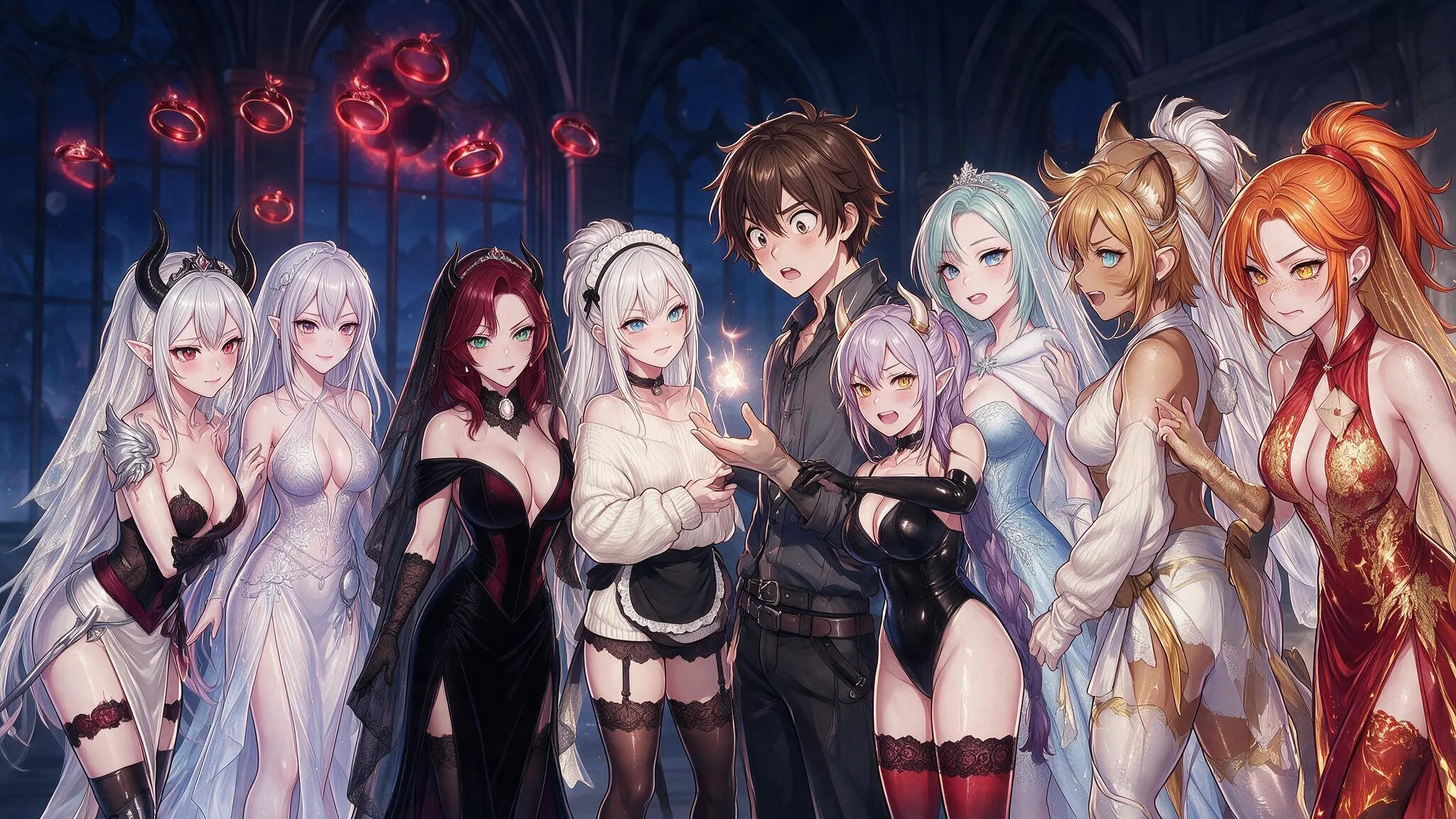
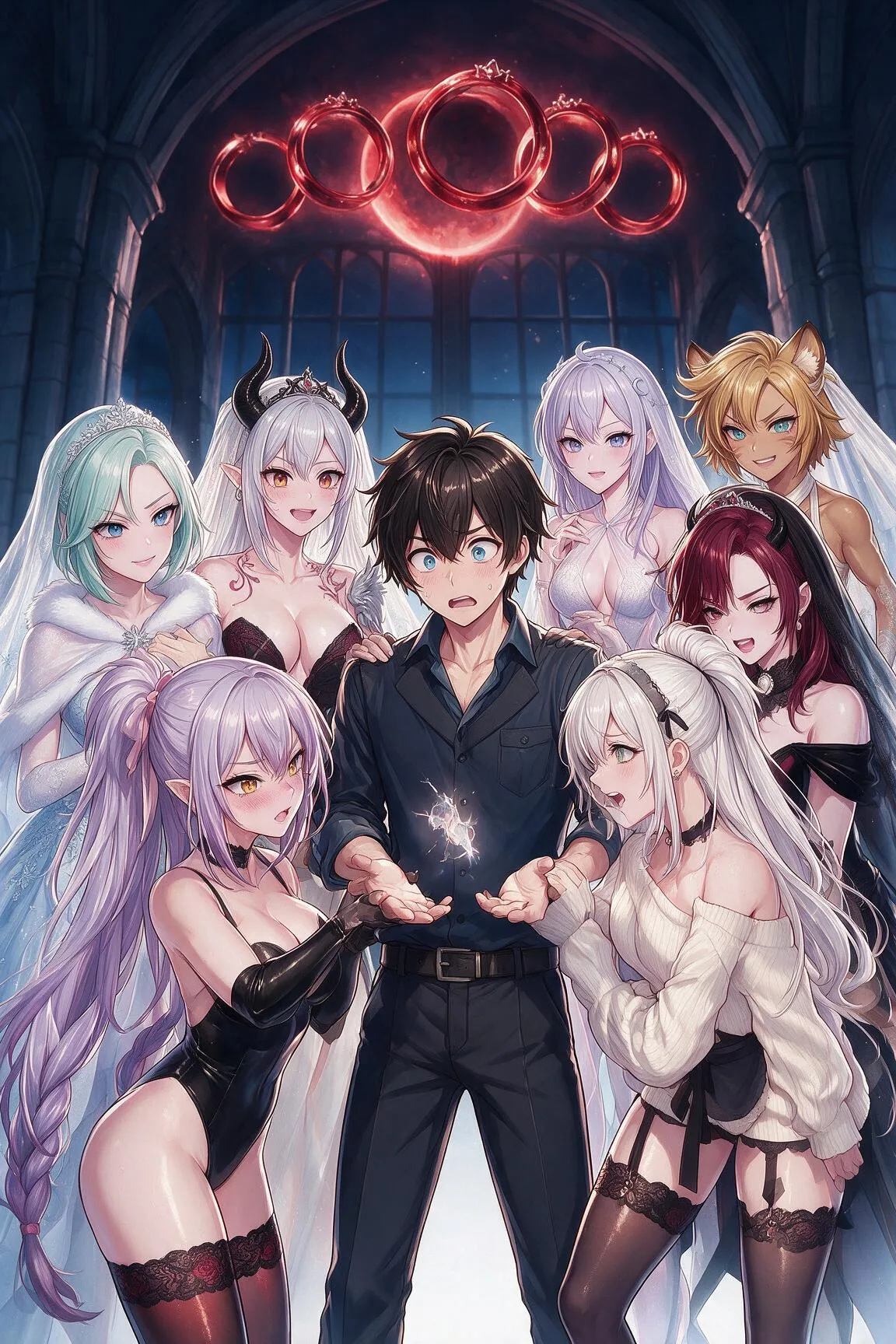
After clearing your favorite harem game 100 times, you wake as its legendary sorcerer, Aldren, with perfect route knowledge and disastrously unreliable magic. From Aldren's Castle, you must capture the attention and win the willing allegiance of seven demon brides before their wedding ritual ends the world. But your quietly possessive maid knows more than she admits, and saving these women means abandoning the walkthrough that taught you how to win them.
The set-up is a joke about the genre itself. The hero, Aldren, has cleared this harem game a hundred times and knows every route. Then he wakes up inside it, and the women he thought he understood turn out to be people. As Elsette, his maid, tells him: “People are not walkthroughs, my lord.”
Structurally it is a classic harem visual novel. There are eight heroines: the seven demon brides and Elsette. Every choice raises one heroine's affection. There are nine endings: one for each heroine, and a normal ending. There is no harem ending where he keeps everyone. That is a common choice in the genre: it lets each route finish on one relationship.
Common harem tropes, with examples
Harem casts are built so that every player has someone to root for, so the heroines tend to fall into recognisable types. Good writing gives each type a want of her own, so she is more than a reaction to the lead. Here is how the types show up in Reincarnated Into Harem Game:
- The devoted one. Elsette anticipates every need before it is spoken, speaks softly and formally, and is jealous in a composed way: she never raises her voice, she simply happens to be standing in the way. She also knows more about the castle than she admits.
- The tease. Mirelle, the curse bride, calls everyone pet and runs a merchant city on debts and threats. The trope's usual turn applies: teasing is armour, and sincere tenderness is the one thing that unsettles her.
- The warrior who wants a quiet life. Veyra, the war bride, commands armies in clipped orders and secretly longs for a life in which nobody needs her sword.
- The elegant one who keeps her distance. Vaelisse, a vampire bride, is immaculately polite because falling in love makes her hunger stronger. The politer she gets, the more she is struggling.
- The shy, mysterious one. Seris, the dream bride, can become anyone's ideal, and is trying to find out what she wants when nobody is watching.
- The rival-to-lover. Thessia, the beast bride, turns courtship into a contest and insists her mate must beat her fairly.
- The confident one with a secret. Avelra, the frost bride, courts with breathtaking confidence, then privately rehearses every conversation she is afraid to get wrong.
The lead is a trope too. Harem leads are often kept vague so the player can step into them. The criticism of the genre is fair: in weaker stories the heroines are told apart only by their hair and one personality trait, and they have no life outside the lead. The fix is to give each one a problem the lead cannot simply solve by being chosen.
Harem as comedy: Everyone in My Party Thinks She's the Main Character (ours)
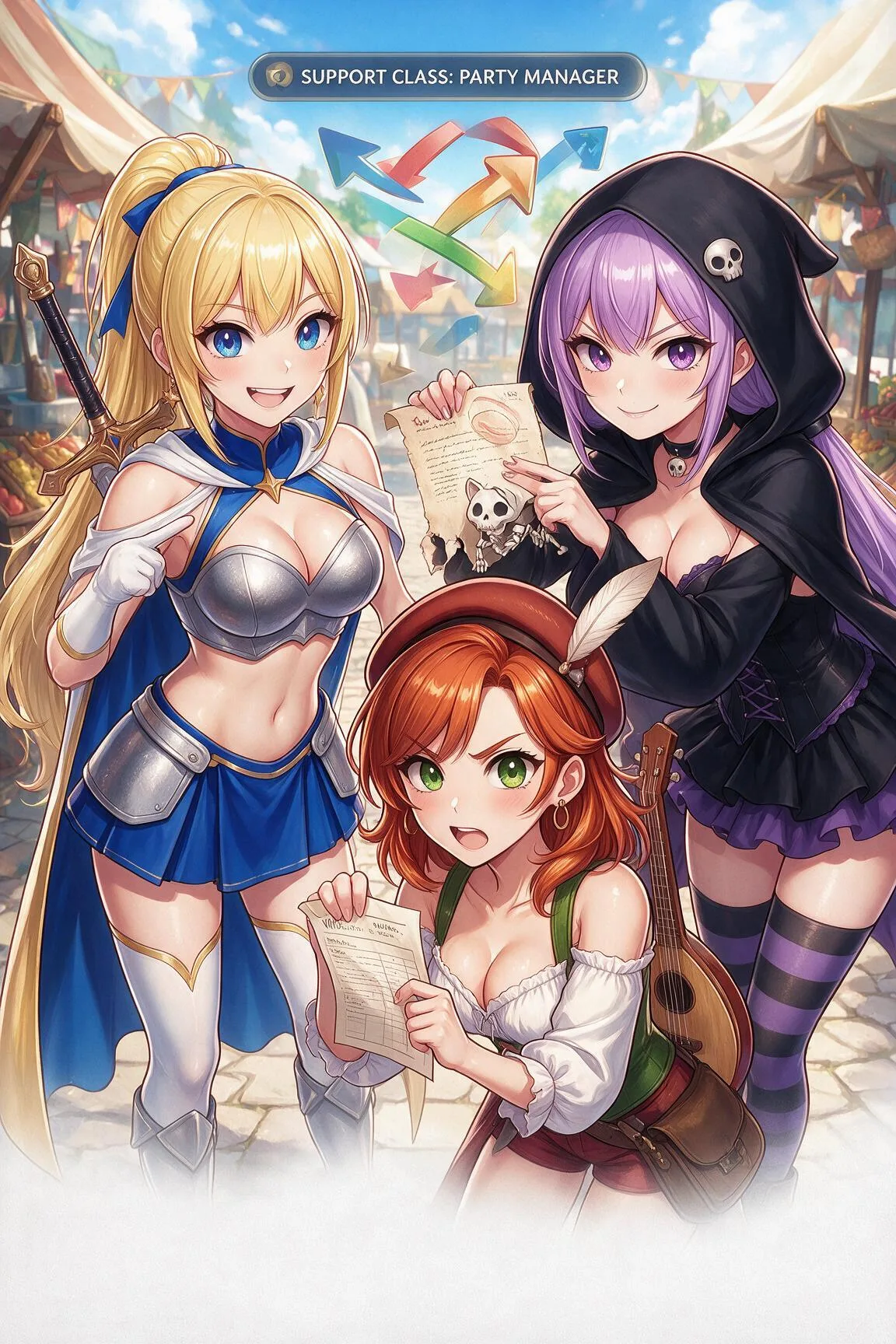
You arrive in Aurelmont as its promised Hero, until the court reads your status: Support Class: Party Manager. Assigned to Pennywhistle's worst adventurers, you juggle three heroines who each consider you her sidekick. Your choices decide whose story takes center stage, while your support skills turn their spectacular failures into a working party. Here the harem tropes are the joke. A self-declared Chosen One, a necromancer who is scared of the dead, and a bard who cannot play her lute each believe she is the heroine of the story. Three heroines, three routes and a normal ending, and a lead whose class is literally support.
Harem vs reverse harem
A reverse harem flips the set-up: the lead is a woman (or sometimes a gay man) and the love interests are men. Harem stories have mostly been aimed at men and reverse harem at women. In games, reverse harem is the usual shape of otome games, story-based romance games made for women, where you play the heroine and choose between several male leads. There are also same-sex harem stories, though fewer. The mechanics are identical: a cast, choices, routes, one ending per love interest.
Why people like harem stories
- Choice. You are not told who the right partner is. You decide, and your favourite gets her own story.
- Variety. One game holds several romances with different moods: a teasing one, a gentle one, a slow-burn one.
- The ensemble. Heroines bickering, scheming and teaming up is often the funniest part.
- Replay. Each route shows a different side of the same events, and other heroines look different from the outside.
- Low pressure. It is a romance where being wanted is the starting point, and the story is about earning it properly.
How routes and endings work in practice
Most harem visual novels track affection in the background. Small choices add up, and a few big ones count for more. If you want a particular heroine, the simplest rule is to be consistent: pick her side when the story asks you to choose between people, and spend free time with her. If you split your attention evenly, you usually land on the normal ending, which is a fine ending, just not anyone's.
In Pomomi's series, each choice raises one heroine's affection and decides whose route you end up on, episodes take a few minutes, and episodes you have unlocked stay on your account to replay, so going back for another route does not mean buying the same episode twice.
If you want to see how it feels, Reincarnated Into Harem Game is free to start in your browser, and the first episode opens on Elsette at your bedside.
Questions
What does harem mean in anime? A story where one main character is surrounded by several possible romantic partners, usually three or more. It describes the cast, not how explicit the story is.
What is a reverse harem? The same set-up turned around: a heroine (or sometimes a gay male lead) with several men interested in her. Many otome games, romance games made for women, have this shape.
What is a harem ending? An ending where the main character ends up with all or several of the love interests at once, instead of choosing one. Many harem visual novels do not have one and end each route with a single partner.
Are harem visual novels adult games? Not necessarily. Some are explicit, many are all ages, and plenty sit in between. Pomomi's harem series are suggestive and for players 17 and over, with no nudity.
Pomomi makes both series used as examples here; no other studio's games are named. Definitions follow common usage in anime and game fandom. Details were correct in November 2026.